Hyperblitz — L1 Intelligence Gateway
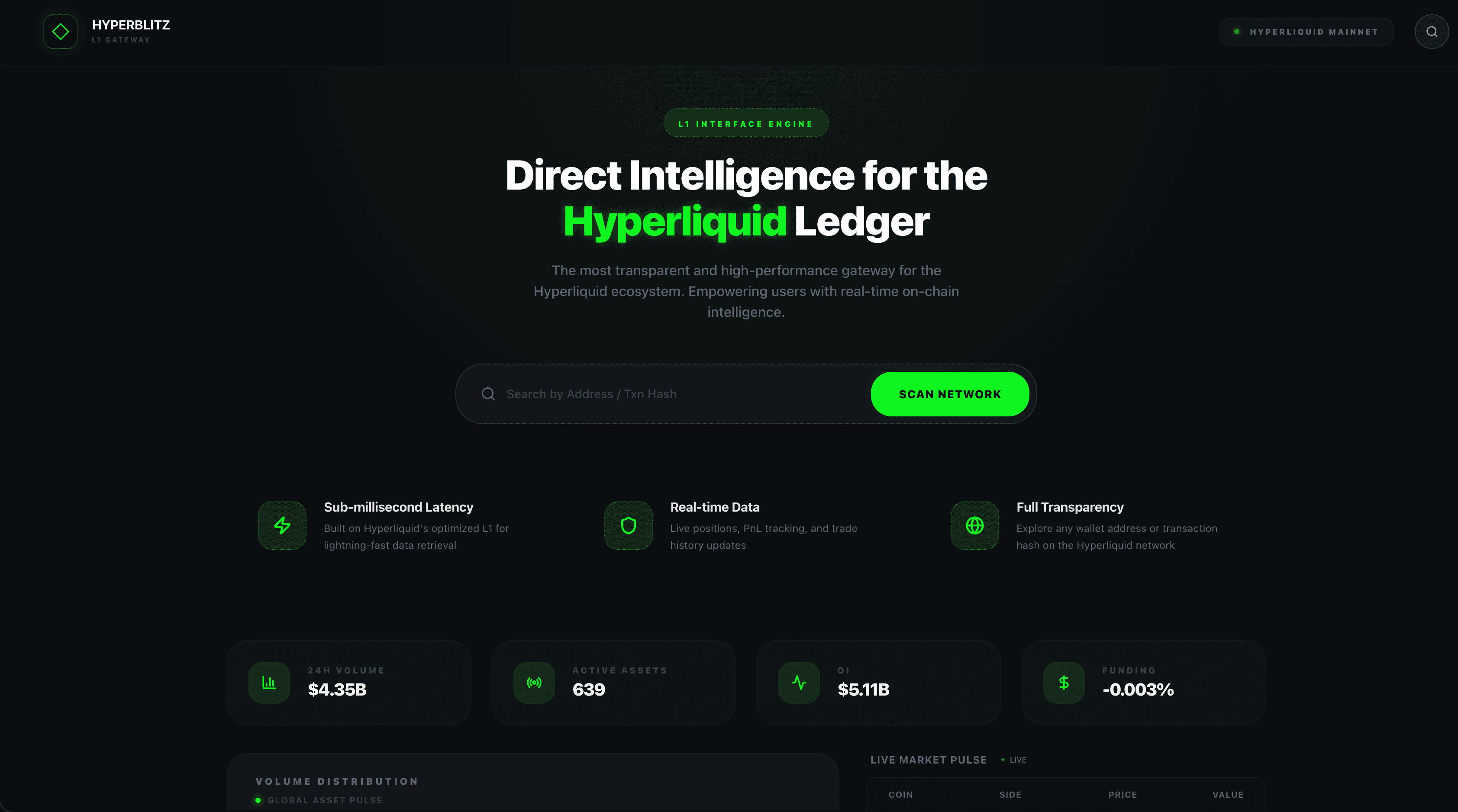
Hyperblitz is a zero-backend, sub-millisecond intelligence gateway for the Hyperliquid L1 ecosystem. It delivers direct on-chain analytics — live positions, PnL tracking, funding payments, staking rewards, and real-time market pulse — all from the browser, with no server, no proxy, and no compromises.
Service
Infrastructure
Platform
Global Deployment
Technical Architecture
Project Overview
Hyperblitz is the most transparent and high-performance gateway ever built for the Hyperliquid ecosystem. Marketed as the "L1 Interface Engine", it gives traders, analysts, and builders direct, unfiltered intelligence into the Hyperliquid ledger — tracking any wallet address or transaction hash in real time, with sub-millisecond data retrieval and zero backend infrastructure.
The Challenge
Building a high-fidelity on-chain explorer for a performance-first L1 like Hyperliquid is deceptively hard. Traditional block explorers rely on centralised indexers, database caches, and backend proxies — all of which introduce latency, potential downtime, and opacity. The mission was to invert this model entirely: deliver a richer product with zero backend, letting the frontend own the complete data pipeline from the raw L1 APIs to the rendered UI.
Engineering Approach
The entire Hyperliquid data pipeline runs client-side. All REST calls flow through a custom HyperliquidProvider layer — a typed Axios client with a token-bucket rate limiter (6 req/s sustained), exponential backoff on 429s, and a 10-second per-request timeout. A singleton ServiceFactory wires all domain modules together as a lightweight dependency injection container, keeping every service independently testable and replaceable.
Real-time market data arrives through a persistent WebSocket connection to wss://api.hyperliquid.xyz/ws. The WebSocketManager subscribes to the allMids and trades channels, deduplicates events by hash, enriches each trade with asset metadata and logo URLs, then fans out to all registered listeners synchronously. A 10ms micro-buffer in LatestTransactions.tsx batches DOM updates, keeping the live trade feed smooth even at high throughput.
Key Features
- Portfolio Dashboard — equity curve, P&L timeline, allocation breakdown, and account health score for any wallet
- Activity Feed — all fills, funding payments, staking rewards, ledger transfers, vault events, and TWAP slices — fully paginated and filterable by asset, type, and action
- Live Market Pulse — real-time global trade stream via WebSocket with zero polling; new trades appear in under 10ms
- Network Stats — 24h volume, open interest, funding rates, global asset radar, and top asset volume distribution
- Holdings Browser — perp positions, open orders, spot balances, vault equity, and staking positions in one unified view
- Transaction Detail — click any event to expand a rich, full-detail panel with every field from the raw ledger
- Sub-account Discovery — automatically walks the sub-account graph so no positions are missed
Architecture Highlights
The codebase follows a strict layered architecture. The components/ layer is UI-only and consumes data exclusively through a thin api.ts façade — it never imports directly from services/features/. The services/ layer is pure TypeScript with no JSX, split into hyperliquid/ infrastructure (HTTP, WebSocket, rate limiting, metadata) and features/ domain modules (Fill, Funding, Ledger, Analytics, Portfolio, and more). All canonical types live in a single types/domain.ts file — no drift, no duplication.
All leaf components are wrapped in React.memo(), event handlers are stabilised with useCallback, and derived data is memoised with useMemo. ErrorBoundary components wrap every major panel so a single API failure never brings down the whole UI. WebSocket auto-reconnects with exponential backoff across up to 10 attempts before surfacing an error state.
End-to-End Data Flow
When a user enters a wallet address, App.tsx validates the input, then fires apiService.fetchDashboard(). The Explorer orchestrator initialises the metadata index, discovers all sub-accounts in parallel, then concurrently fetches full activity history, all balances, and the historical equity curve. Analytics.calculateStats() computes P&L, volume, and account health from the aggregated raw data. The complete DashboardData object is set into React state and the entire UI renders in a single pass — no waterfall, no skeleton-for-skeleton loading.
Results & Impact
Hyperblitz launched as one of the first dedicated, zero-backend block explorers for the Hyperliquid L1. It tracks $5.92B+ in 24-hour trading volume and $5.26B in open interest across 642+ active perpetual and spot assets in real time — all without a single server request being routed through an intermediary.
The fully static SPA ships to Vercel in seconds and runs at Cloudflare edge globally. The entire bundle requires no environment variables, no API keys, and no infrastructure management — it connects directly to Hyperliquid's public APIs and delivers a Bloomberg Terminal-grade experience in the browser.
Philosophy: Direct Intelligence
"Direct Intelligence for the Hyperliquid Ledger" is not a marketing line — it is an architectural commitment. Every design decision, from the token-bucket rate limiter to the WebSocket deduplication hash map, exists to ensure that what users see on screen is a faithful, low-latency mirror of the actual chain state. No stale caches, no backend transformations, no hidden indirections. Just the ledger, rendered.
Engineered with